
What this service solves
Overhead damage, texture transitions, and the finish that ties them together.
Ceilings reveal unevenness differently from walls, so repair, texture, and paint share one visible plane.
Damaged ceiling areas
Localized openings, compromised sections, and earlier repairs can be reviewed for repair and painting.
Texture questions
Existing texture or a patch transition can be assessed without promising an invisible match.
Stains after correction
A stain can be prepared and finished only after its source is corrected by the appropriate trade.
Final ceiling painting
Evaluate the repaired area with its surrounding ceiling before scoping primer and paint.
Ceilings in existing homes
One overhead plane can contain several eras of work.
Lakewood and Greater Cleveland homes may combine plaster ceilings, later drywall, prior openings, old patches, and added texture. Window light can emphasize their transitions.
That history is context, not a diagnosis. Hidden structure, active water entry, ventilation problems, or hazardous materials require the appropriate specialist.
An overhead workflow
Cause, condition, texture, then finish.
The sequence is adjusted to the ceiling condition, repair area, texture, and finish scope.
Confirm the source is resolved
Confirm any leak, movement, or underlying issue has been handled by the appropriate trade.
Review the ceiling plane
Document damage, seams, patches, texture, fixtures, edges, and available light.
Protect and prepare
Agree on access and protection, then prepare only what belongs in the surface scope.
Repair and address texture
Complete the repair and relate matching or new texture to the surrounding ceiling and realistic limits.
Prime, paint, and review
Apply selected finish steps, then review the ceiling from normal viewpoints under available light.
Before ceiling work starts
Cosmetic repair should not conceal an active problem.
A stain or crack does not reveal its cause. The next step may begin outside painting scope.
- Active roof, plumbing, condensation, or other water sources require correction before surface repair.
- Sagging, recurring movement, or structural concerns require qualified evaluation.
- Suspected lead, asbestos, mold, or another hazard requires assessment by the appropriate specialist.
- Texture matching depends on the surrounding pattern, age, repair area, lighting, and normal viewing conditions.
Ceiling work in progress
Repair and surface application, shown clearly.
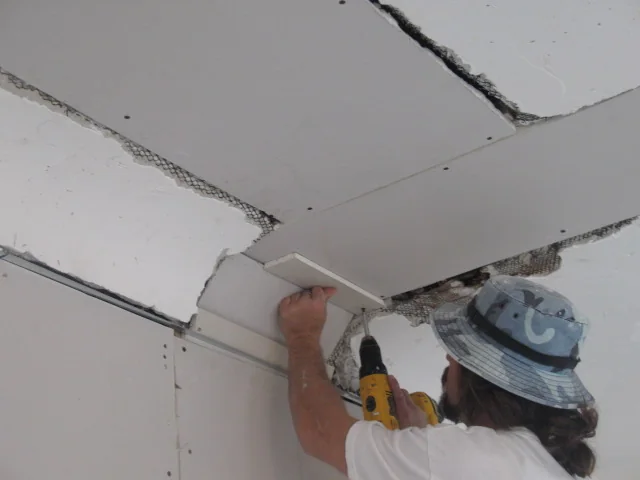
The hero shows active ceiling repair. A separate view below shows surface material being applied across a ceiling.
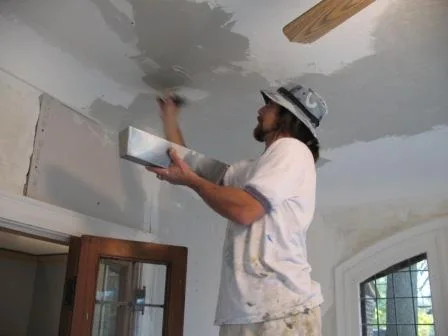
These are separate examples of ceiling repair and surface application, not two stages of the same room.
Planning questions
Ceiling Repair & Texturing FAQs
Can a ceiling stain be painted after a leak?
Only after the source is corrected and the ceiling suits surface work. Cosmetic work should not conceal an active leak or recurring moisture.
Can you match an existing ceiling texture?
It can be evaluated, but pattern, age, repairs, lighting, and area size affect what is realistic. An invisible match is not promised.
Is ceiling texturing the same as skim coating?
No. Texturing works with a visible pattern; skim coating is broader smoothing. The current ceiling and desired finish determine the choice.
Will ceiling repair create dust?
Preparation and sanding can create dust. Discuss room protection and dust-management expectations before work begins.
Can the repaired ceiling be painted as part of the project?
Yes. The estimate can define the repaired area, surrounding ceiling, primer needs, and painting extent.
What if the ceiling is sagging or keeps cracking?
Recurring movement or sagging may require a qualified specialist before cosmetic repair. An on-site evaluation is needed to determine the appropriate next step.