
What this service solves
Broad visual inconsistency across a wall or ceiling plane.
Skim coating belongs when the issue spans a surface rather than one damaged spot.
Widespread unevenness
Many visible highs, lows, or transitions may need broad treatment instead of disconnected patches.
Residual texture
An existing surface pattern may be evaluated for a smoother painted appearance.
Many prior repairs
Scattered patches reflect light differently; a suitable broader plane may need one coherent base.
Finish-readiness
Surface refinement connects directly to the primer and paint decisions that follow.
Surface evaluation first
Older does not automatically mean skim coat it.
Lakewood and Greater Cleveland homes can combine plaster, drywall, old repairs, layered paint, and texture. Side light emphasizes variation, while trim complicates edge work.
A stable, broadly inconsistent plane may be a candidate; an isolated hole may need only a patch. Active movement, moisture, failing material, or hidden conditions require another answer.
A layered process
Evaluate, prepare, build the plane, then finish.
Application and sanding vary by surface. Scope should define the sequence without a fixed coat count or drying time.
Evaluate suitability
Review stability, damage, texture, coatings, edges, fixtures, and desired appearance.
Prepare the surface
Address agreed repairs, remove unsuitable loose material where scoped, and prepare the plane.
Apply in planned stages
Build the surface in stages suited to its condition, not a universal formula.
Refine and manage dust
Refine as required with project-specific protection and dust-management expectations.
Prime, inspect, and paint
Prime as scoped, inspect under available light, and complete the agreed paint finish.
When another answer is better
A finish layer cannot solve an unsound or active condition.
Some surfaces need a localized repair or specialist evaluation instead of a broad skim coat.
- Isolated cracks or holes may call for localized repair instead of broad coating.
- Active movement, water intrusion, moisture, or structural concern requires the appropriate specialist first.
- Suspected mold, lead, asbestos, or another hazard requires assessment by the appropriate specialist.
- Texture, substrate variation, lighting, and the agreed scope all influence the final appearance.
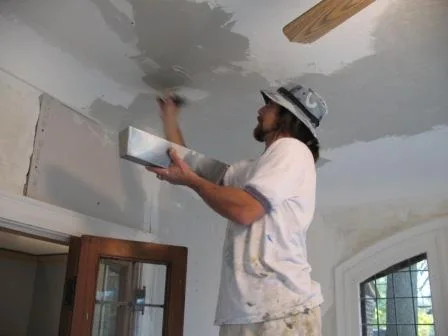
Surface work in view
Skim-coat application and a completed interior finish.
The hero shows the application process. The completed room below shows a separate Allure interior finish.

The application and completed-room images show separate projects and are presented as distinct examples.
Planning questions
Skim Coating FAQs
What is the difference between skim coating and patching?
Patching addresses localized damage. Skim coating is evaluated across a broader plane with widespread texture or unevenness.
Can every wall or ceiling be skim coated?
No. Stability, adhesion, prior coatings, damage, movement, moisture, and desired finish must be reviewed first.
Does skim coating make a surface perfectly smooth?
It can support a smoother appearance on suitable surfaces, but condition, light, edges, and scope affect results. Perfection is not promised.
Is sanding part of skim coating?
Refinement may include sanding between or after stages. Set dust-management expectations for the project.
Can skim-coated surfaces be primed and painted?
Yes. Once ready, the estimate should define the priming, painting, areas, and steps included.
How long does skim coating take?
Timing depends on the area, condition, number of stages, drying environment, and finish scope. The estimate can address the expected sequence for your project.