
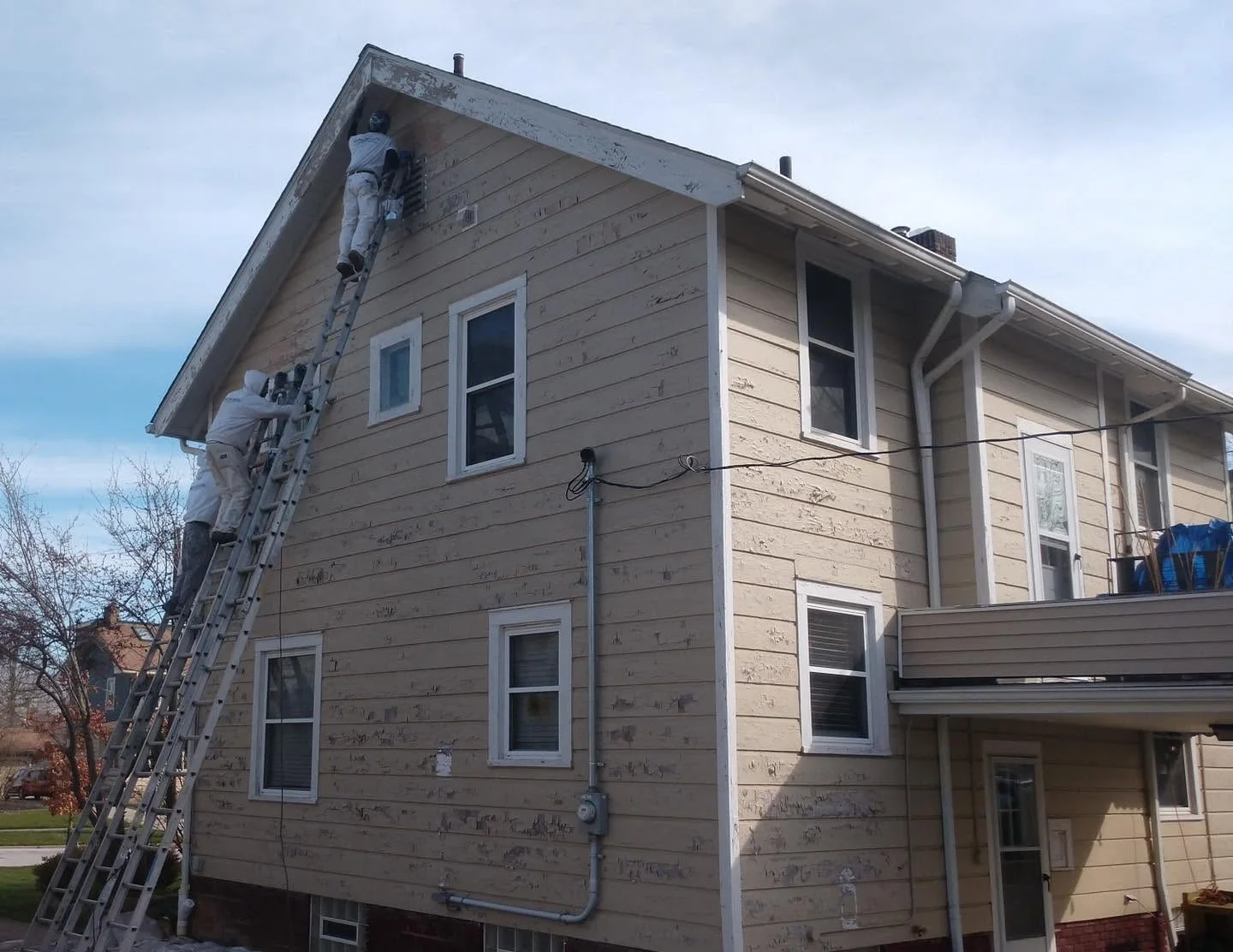
Preparation starts by explaining the failure
“Prep included” is too vague to compare proposals. Before a method is selected, the painter should identify what material is present, how the existing coating is behaving, and whether water, movement, contamination, or damaged material is contributing to the problem. Scraping may be appropriate for loose paint on one surface and irrelevant on another. Caulk belongs at appropriate joints, not across every opening. Primer selection depends on the exposed material and coating plan.
A useful preparation scope connects each action to an observed condition. That makes the work understandable to the property owner and prevents a long generic checklist from sounding more rigorous than it is.
Inspect and separate the surface types
Begin by mapping the exterior: siding, trim, fascia, soffits, doors, porches, railings, and other included components. Note whether the materials are wood, metal, vinyl, masonry, or another substrate. Record coating failure, open joints, damaged areas, corrosion, chalking, staining, and access constraints.
The inspection should also distinguish paint work from another problem. Active leaks, failed flashing, substantial decay, loose assemblies, structural movement, and other underlying conditions may require correction by the appropriate trade. Coating over the symptom does not correct the cause.
For older homes, the age and coating history matter. Painted surfaces in many pre-1978 homes may be subject to federal lead-safe renovation requirements when work disturbs the coating. An estimate should not presume a surface is lead-free because it looks recently painted; older layers may remain below.
Protect the site and plan safe access
Preparation creates debris, dust, wash water, and movement around the property. The scope should account for adjacent surfaces, landscaping, doors and windows, fixtures, vehicles, pedestrian paths, and nearby property. Access methods and containment must fit the building and the work being performed.
If regulated lead-safe practices apply, EPA requirements affect containment, work methods, cleaning, and documentation. Property owners should use current EPA guidance and discuss the requirements relevant to the specific job.
Clean for a bondable surface
A surface may carry dirt, chalk, biological growth, atmospheric residue, or other contamination that interferes with adhesion. Cleaning should be selected for the material and condition rather than treated as a ritual. Aggressive pressure can damage wood, force water into assemblies, or mark softer surfaces. Insufficient cleaning can leave a weak layer under the new coating.
The important result is a clean, sound, and sufficiently dry surface—not a particular machine. The scope should also allow the material to dry under appropriate conditions before subsequent steps.
Remove paint that is no longer sound
The National Park Service emphasizes the least aggressive effective treatment for historic exterior wood. That principle is useful more broadly: remove coating that is loose or failing to the extent needed for a sound edge and substrate, rather than assuming every project requires total stripping. The correct extent depends on adhesion, layer buildup, details, condition, and the intended coating system.
Scraping, sanding, or another method must also fit the material and safety requirements. A photo of visible scraping proves that activity occurred at that moment; it does not prove how the entire property was prepared. A clear proposal should identify the included areas and performance objective.
Refine edges and correct paint-related defects
After loose material is removed, abrupt coating edges and rough transitions may remain. Sanding or other refinement can reduce those edges and prepare a more coherent profile where safe and appropriate. It does not make aged, layered exterior material perfectly new or erase every historic irregularity.
Damaged wood, failed fasteners, loose components, or other repair needs should be identified rather than hidden. Allure can discuss painting-related preparation and minor repair needs; structural repair, engineering, roofing, and active water-intrusion correction belong with the appropriate specialist.
Address appropriate joints and gaps
Caulk can help at compatible joints that are intended to be sealed, but indiscriminate caulking can block drainage or movement. The location, joint size, adjacent materials, and coating plan matter. A proposal should say which joints or gaps are included and avoid presenting caulk as a cure for failed assemblies or water entry from another source.
This is also a good point to confirm which windows, doors, penetrations, and trim interfaces are in scope. “Exterior included” can mean very different things unless components are named.
Prime where the system requires it
Primer is not merely an extra line item, and one primer is not right for every exposure. Bare substrate, repairs, stains, corrosion, a substantial color transition, or coating compatibility can change the priming plan. Some surfaces call for spot priming; another condition or coating system may require a broader approach.
Ask what will be primed, why, and how the primer relates to the substrate and finish. Avoid a proposal that treats an unspecified “coat” count as the only measure of quality. Preparation, material compatibility, film application, and actual coverage all matter.
Confirm readiness before finish coating
Before coating begins, the surface should be sound, clean, and dry enough for the selected system, with repairs and preparation complete to the agreed level. Surface temperature, forecast conditions, dew, wind, shade, and manufacturer instructions can all influence the work window. The calendar month alone does not establish readiness.
A quality review should be tied to the written scope: included surfaces, excluded repairs, agreed preparation, coating plan, color placement, and visible completion items. It should not be replaced by a broad promise that every old surface will appear flawless.
Questions that make an exterior proposal easier to compare
Ask each bidder:
- Which substrates and components are included?
- What failure or contamination was observed?
- Which areas will be cleaned, scraped, sanded, repaired, caulked, or primed?
- What is explicitly excluded or requires another trade?
- How will adjacent property and landscaping be protected?
- How will pre-1978 painted surfaces be evaluated for applicable requirements?
- What conditions determine whether coating can proceed?
- How will changes in discovered condition be documented?
The strongest answer is not automatically the longest list. It is the one that explains why each step belongs to the actual property. For timing and maintenance context, read how often to paint a Northeast Ohio exterior. To discuss a specific scope, visit exterior house painting.
Technical and safety references
These references offer general planning guidance. Use the estimate conversation to discuss the actual property, surface condition, and project scope.
- Preservation Brief 10 — Exterior Paint Problems on Historic Woodwork — National Park Service. Explains diagnosis, limited removal, preparation, moisture, and repainting considerations for historic wood.
- Steps to Lead-Safe Renovation, Repair and Painting — U.S. Environmental Protection Agency. Provides current federal safety and compliance context for covered paint-disturbing work.